Very Very Far Away (VVFA): From Dissemination to Anticipation
Citation: Rakotoniaina, S., Friend, A. and Blasco, J. (2017) Very Very Far Away (VVFA): From Dissemination to Anticipation. 68th International Astronautical Congress, Adelaide, Australia, 25-29 September 2017.
Authors: Sitraka Rakotoniaina, Andrew Friend and Jasmin Blasco
Presented at: 68th International Astronautical Congress (IAC), Adelaide, Australia, 25-29 September 2017
Paper ID: IAC-17-E1,9,1,x39006
Abstract
Very Very Far Away (VVFA) is a public facing research platform composed of a radio podcast, a website, and a workshop series, seeking to re-ignite future ideologies. Its methodology uses space exploration as a lens to examine current ideas and values which may pertain to future societies through technological advances.
VVFA focuses on democratising future narratives, through exploring multiple perspectives simultaneously, and disseminating new cultural fictions. Bringing members of the public and experts together through workshops, we collectively craft a web of stories capturing new space potentials, subsequently documented and disseminated via podcast on dublab.com, iTunes, Acast, and Soundcloud. This process enables the conceptualisation of future worlds, through which newly formed ideologies can permeate the public realm.
Today’s society is based on collectively agreed upon fictions. Cultural beliefs appear to be dominated by a “utopia of normality”, characterised by an absence of anticipation, where future projections can be perceived as speculative predictions omitting major societal aspects by primarily focusing on technological prowess, resulting in nothing more than exercises in escapism.
Conversely, proposing space exploration as a lens to examine today’s narratives encourages participants to take a step back and re-evaluate cultural values informing technological development in space whilst empowering them to create long-term cultural projections.
VVFA articulates two approaches: collaborative world creation, an inspirational strategy established around scientific, social and ethical questioning induced by space exploration; and reverse archaeology, the embodiment of future narratives into designed artefacts, services, and other forms, similarly to the way the Pioneer Plaque and Voyager Golden Record embodied the values of their time.
Keywords: Speculative Design, Reverse Archeology, Podcast, Future
1. Introduction
The space race of the mid-20th century has long been the symbol of technical prowess and mankind’s achievements. The risks, dangers and political climate that fathered space exploration, eclipsed by multiple extraordinary scientific and technological breakthroughs, have profoundly impacted our modes of living, from telecommunications and navigation systems to infrared ear thermometers and virtual reality.
Throughout this technological endeavour, the impact of the space-age has been extremely diverse, fuelling popular culture with the hope of mankind becoming a spacefaring species and eventually creating a sense of togetherness. This idea is embodied by a vast number of cultural icons, from cinema, architecture, art and design.
From buildings to transportation systems and everyday objects at home, the cultural impact of the space-age has had not only an aesthetic influence, but has also brought about a form of collective aspiration, enabling future societal projections and narratives to emerge. Some of these can be seen as the anticipation of forthcoming achievements.
Whilst we cannot decouple the space-age ideology from the political agenda of the nations involved, we could argue that to some extent, the space-age has fostered a new global identity: a cultural awareness of humanity moving forward and into the future as a whole.
“Greetings, my friend. We are all interested in the future, for that is where you and I are going to spend the rest of our lives.”
Plan 9 from Outer Space - Ed Wood [1]
For the past 60 years, space exploration has been woven into society’s fabric. It is a perspective-altering endeavour that has shaped worldviews and cultures, paving the way to a better understanding of Earth as a living system, but also providing the framework that enables us to think about humanity’s future, be it in utopian or pragmatic terms.
1.1 What About Now?
Today, the technological paradigm, engendered by the digital revolution, has led to the acceleration of innovation manifest through a permanent state of disruption. It is a new state of affairs, promoted by fast-moving digital companies in the West, and leading to fast changes that often outpace our social structures.
This status quo has brought about the emergence of a “utopia of normality,” a drive to “get everything back to normal,” and a desire for stability. This sentiment can also be interpreted as a desire for a return to the foundational values of liberal democracy, characterised by a form of redistribution and regulation that may seem incompatible with the accelerationism advocated by the tech industry in the West.
This disruption causes today to be what Bernard Stiegler calls an “age without an age,” characterised by the lack of positive and shared anticipations, preventing us from looking to the future. Our collective demoralisation leads to a fear-induced paralysis focussing on the projected disastrous effects of climate change, and the potential for regressive scapegoating [2].
1.2 Collective Aspirations
Given today’s circumstances, it seems relevant to draw from the cultural impact and enthusiasm brought about by the space-age of the mid-20th century, to re-ignite a collective idealism. But how can we reinvigorate global aspirations?
Science fiction often uses speculation about the future as a way to analyse the present. In some ways, science fiction and science reality may be the endpoints of a feedback loop process: Arthur C. Clarke describing the use of communication satellites in Wireless World in 1945, William Gibson coining the term cyberspace in 1982, or the film WarGames in 1983 leading to Reagan’s National Policy on Telecommunications and Automated Information Systems Security directive in 1984.
The author Neil Gaiman likens fictions and stories to “symbiotic organisms that we live with, that allow human beings to advance” [3]. This shares similarities with Yuval Noah Harari’s idea that humanity’s evolutionary success is partly due to our capacity to cooperate flexibly with countless strangers through shared fictions [4].
VVFA first started as a method for engaging young designers with the values and cultural identities underlying the development of new and emerging technologies at various educational institutions. It organically grew into a public-facing platform focussing on enabling conversations and the elaboration of collectively crafted new cultural fictions.
Using space exploration as a lens to view collective aspirations, VVFA proposes a framework to help examine and think about future potentials. Its method is primarily inspired by the way individuals gather and experience information, and the styles of narratives we create to make sense of their potential complexity.
In essence, VVFA proposes a bottom-up approach to thinking about the future, and encourages the creation of a web of entangled narratives seen through the perspective of individuals and the design of artefacts and services. These can be assessed, questioned and critiqued in relation to preconceived aspirations, a process we refer to as world creation, aiming not only at addressing what technology makes possible, but also what is preferable, whilst enabling us to imagine what these futures might feel like.
2. Democratisation
Before discussing VVFA methods and outcomes, it is important to address a few foundational points impacting how future narratives are currently informed.
2.1 A Narrative Construct
In spite of the fact that everyone’s actions today will impact the individuals and groups of tomorrow, the future, as a narrative construct, is not democratic. Most of us may feel that the future just happens, and perceive it as being an unfamiliar land, mostly inhabited by technological projections and technological beings with whom we may or may not identify.
For most of us, tomorrow’s individual has a technological identity. We often assume that it has come into being in favour of humanity’s greater good: that science and future technologies will solve today’s issues and enable a better tomorrow. However, it seems that we rarely question or define the foundational values implicit in the normative use of “better.”
This quantification of “better”, combined with the absence of cultural drive, seems to deprive the social imaginary from its capacity to project and anticipate. Future narratives may appear to be in the hands of a few companies and technology makers, as outer space opens up pathways for private ventures in telecommunications, tourism and mining.
2.2 The Role of Democratised Futures
Conversely, VVFA favours diversity and encourages the imagination of new possibilities by democratising future narratives through shared perspectives and understanding, hoping to engage the collective imagination.
VVFA proposes to act as a platform from which shared visions can emerge and individual narratives can be questioned and examined. The public-facing co-enquiry aims at engaging the public with ideas, values and belief systems intrinsic to the development of technology and therefore the manufacture of future narratives.
These fictions are not proposals for future modes of living, but rather a wider mapping and exploration of possibilities, seen through a prism that encompasses our social, cultural, political and ethical relationship with potential futures, broadening their predominantly technological scope whilst focussing on the human experience.
As an example, during a four-week co-enquiry run at Casa Jasmina in Turin, an Internet of Things pilot apartment founded by Bruce Sterling and Jasmina Tesanovic together with Officine Arduino, participants imagined and developed new, critical relationships with “smart” objects and the technology’s mediation of human communication.
The outcomes were exceptionally diverse, ranging from a Twitter-enabled fire to “empathy warfare” and a growing trash can. The latter focussed on how objects can nonverbally communicate with us and influence our behaviour. Its designer, Matthew Visco, wrote that “the object itself promotes laziness, but its intrinsic absurdity generates self-awareness and potentially leads to corrective behaviour” [6].
The objects here, although created following a design process, acted as icons opening up a conversation about preferability. By questioning future potentials, these objects can subvert potentials and hint at new narratives.
3. Method
VVFA is a wide-ranging investigation broadly looking at possible futures, with a view to human, technological and societal engagement with the potential of these futures. The project is constantly evolving, taking on multiple forms and formats as a way to address and engage a wide audience. Over the last three years, three main focus areas have emerged: co-enquiry, podcast and event.
The co-enquiry is a development on traditional workshop methodologies, employing at once pedagogical and research processes with a diverse group of individuals, each bringing their own views, expertise and understanding to the development of concepts.
The podcast is derived from the co-enquiry, as a form of documentation, dissemination and promotion. It takes the form of a designed fiction based directly upon research developed during the co-enquiry.
The events provide a live physical manifestation of the project. These may take varying forms, from traditional gallery installation to more experimental formats such as the VVFA Radio Performance and Workshop at the Victoria and Albert Museum in September 2017.
3.1 Academic and Cultural Precedents
Moving beyond traditions of science fiction, the designed fiction takes a more critical standpoint.
The designed fiction’s lineage derives partly from the architectural discourse that took place in and around London’s Architectural Association in the mid-20th century. Groups such as Archigram embraced the new technology of the age and melded pop cultural iconography in the pursuit and design of possible new worlds.
Architects such as Rem Koolhaas challenged the ways in which the city was formed and lived in [7], while groups such as Archizoom and Superstudio questioned the scale, speed and development of technology at both urban and domestic scales. Dialogues emerging in London’s Royal College of Art in the early 2000s coined the term Critical Design in an often technology-centric examination of possible, preferable and potential futures.
Within our practice we have come to define a process which relates to speculations justified and based on real technological developments, set in parallel to a traditional design process, and engaging a wider cultural conversation about the preferential aspects of said technology or advance.
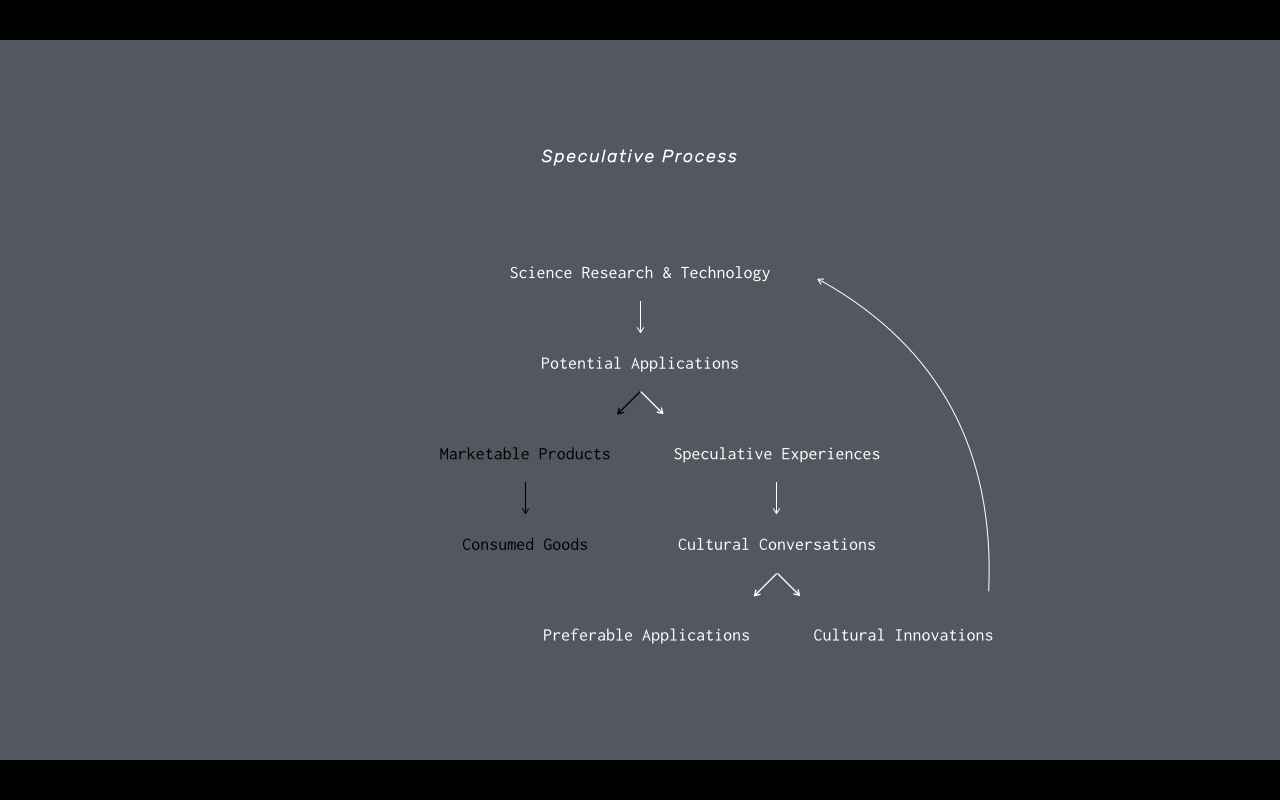
“Speculative design could be a valuable addition to public debate about the social, cultural and ethical impact on everyday life of emerging and future technologies.”
Dunne and Raby [9]
VVFA uses guided speculation as a tool for anticipating possible futures. By guided speculations we refer not to fantastic or scientific fiction, but to speculations based on a real, tangible area of research, be it technology or development. The speculation then evolves through the prism of the researcher, adding their own stance based upon their opinions, experiences and expertise.
3.2 Designed Fictions
The VVFA co-enquiry takes the form of a facilitated workshop where members of the public or students work to collaboratively build a world of entangled narratives focussing on the potentials of the Very Very Far Away. The workshop format varies in duration and number of participants, ranging from single-day sessions to longer enquiries lasting up to one month.
The initial structure and aim of the co-enquiry remains consistent: a process of collaborative world building from the base up, developing a detailed context from which to justify and formulate further speculation. It also serves to develop directions for the podcast.
The workshop begins with an introduction of the overall VVFA project and a description of the session’s goals. Participants are then directed in groups to create a timeline as a basis upon which speculations can be mapped, and their lineage traced, providing a level of plausibility to their ideas.
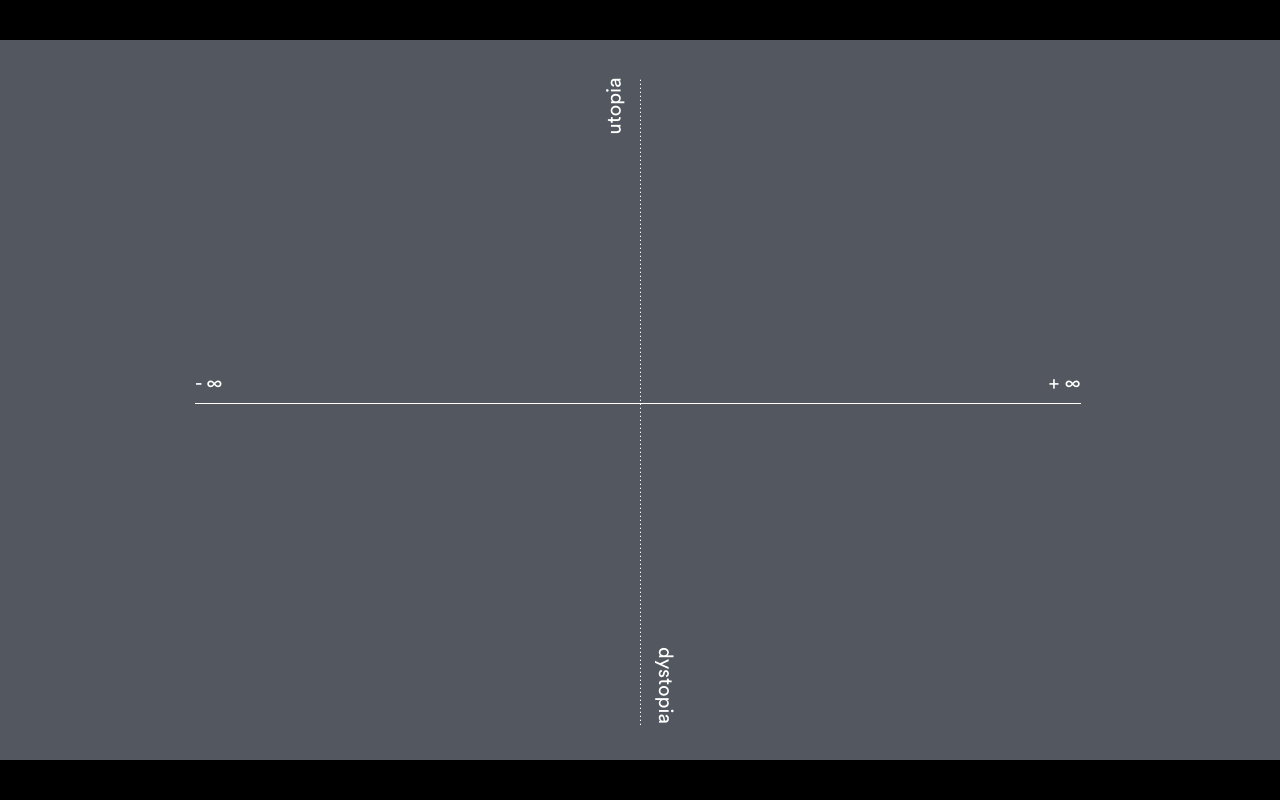
Timelines used in the co-enquiry differ from the traditional single-axis format, as a vertical dimension is incorporated. Speculations and their associated lineage are mapped from an infinite point in the past to an infinite point in the future, while the vertical axis provides a scale ranging from dystopic to utopic idealism.
Over the course of the co-enquiry, a series of prompts are given to each group. Previous context prompts have included space mining, physiology, resources and power, habitation and farming. These prompts have led to discussion around the ownership of extraterrestrial services, life off planet, physiology in space, and terraforming.
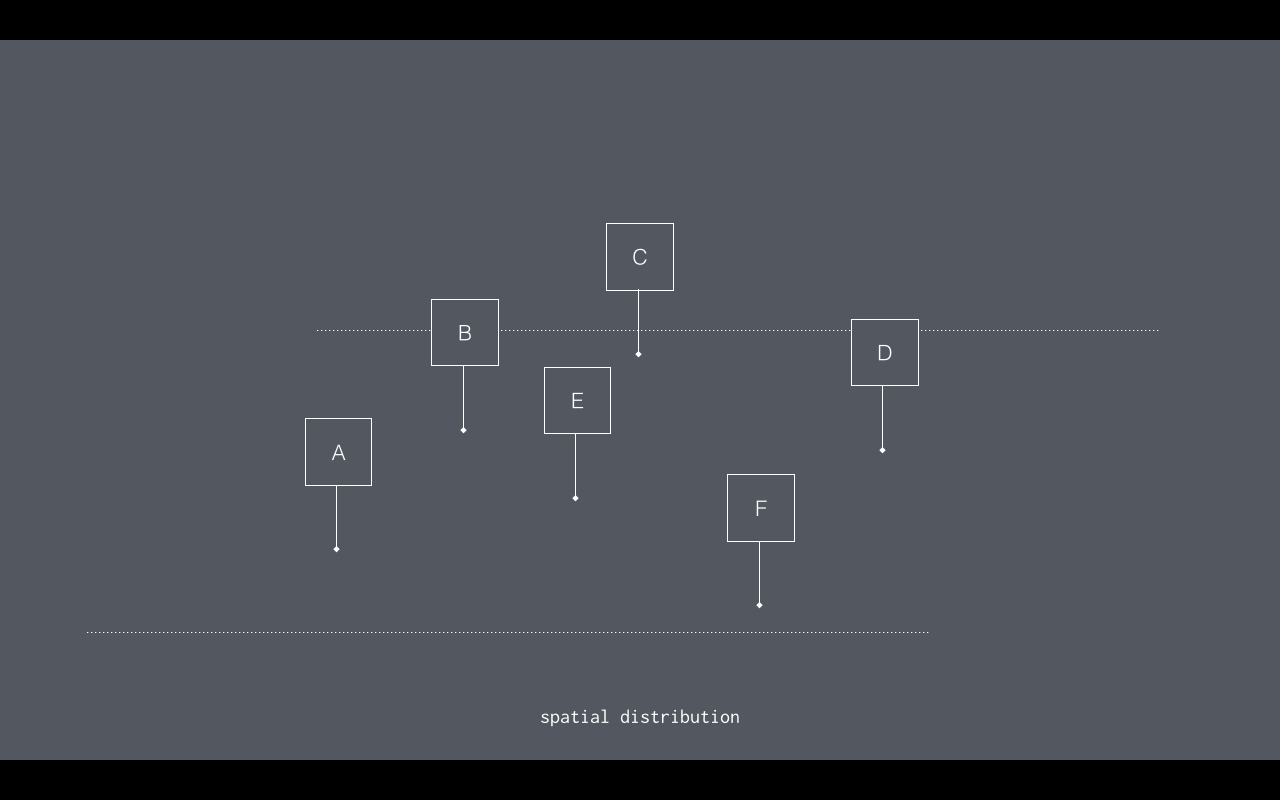
The resultant timeline can start to form nodes of interest around certain key contextual points. From these nodes, we can extract potential narrative or story elements in a process of story mining.
3.3 Story Mining
This initial context forms a base for a second layer of detail to be added onto the timeline as we start to question why, and what the motivations for such development could be.
Participants are given motivations and tasked with addressing their timelines through the lens of what that motivation may be. Motivations used in recent co-enquiries include profit, sustainability, fame, beauty and greater good.
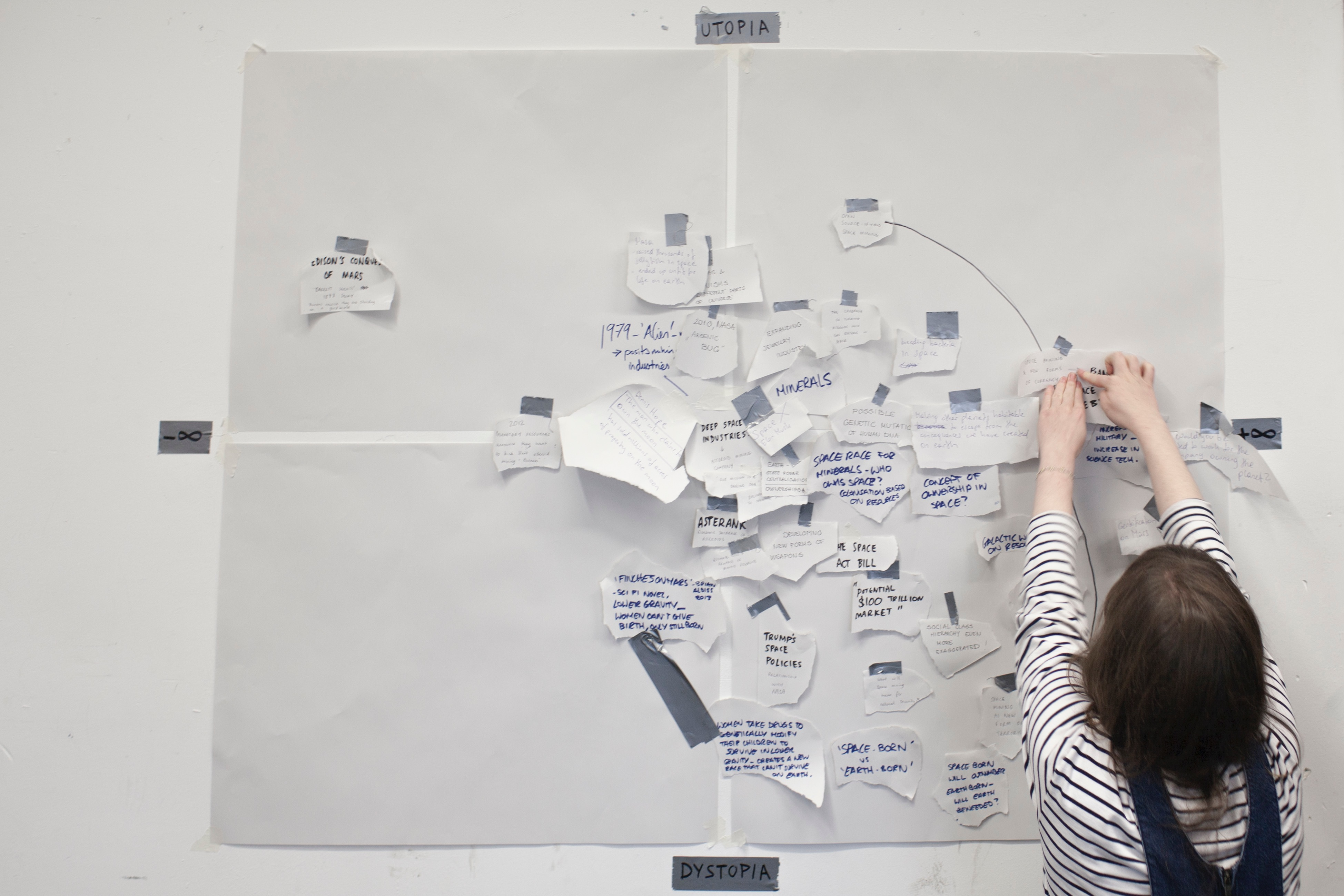
The layering of motivations onto the initial context allows multiple perspectives to emerge. This is partly brought about by the diverse mix of participants attending the co-enquiry, and their individual expertise and experiences being brought into account whilst discussing and building depth to the speculation.
Through timelines created with post-graduate interdisciplinary design students at the University of Northwestern Switzerland, utopian notions of an afterlife came about, whilst critically countered by the corporate ownership of data and possible exploitation of this afterlife. It thus exposed a duality: eternal life versus the possible exploitation of your data and associated rights or identity.
The final set of prompts is the addition of characters, adding perspectives and starting to highlight particular narrative and story elements from within the worlds created. Narrative is embodied, providing a vehicle for possible ideologies in an accessible format.
3.4 Reverse Archaeology
The process of crafting narratives from within nodes and key points uncovered with the timeline can be likened to a reverse form of archaeology, whereby possible points in the future are identified, and through the development of the world that they inhabit, a new context is imagined. This process allows a wider audience to more easily envisage and relate to the futures proposed.
This works in a two-fold manner: that of fiction with design or technology at its core, and that where the use of a designed icon or diegetic prototype becomes the heart of the fiction and a tool for speculation.
Through crafting the objects, situations and scenarios that depict possible futures in a way that is accessible, we are able to form perceptual bridges enabling a wide audience to experience and envisage themselves within the speculated future.
The scope of the designed icon can also extend to the icon as a tool for communication to an envisaged future. The Pioneer Plaque, designed by Carl and Linda Sagan with Frank Drake, attempts to preempt the archaeologist, providing a distilled representation of our present and an embodiment of humanity to be read by unknown entities at an unspecified time in the future.
3.5 Documentation
The final part of the co-enquiry goes through an analysis of the timeline and process of narrative extraction. Key points of interest are highlighted through group conversation and developed to form the skeleton for a new designed fiction, telling the story through varying means depending on the duration and context of the co-enquiry.
During the co-enquiry at FHNW in Basel, participants were asked to design short interview dialogues and develop these into recorded audio plays. The net result became an audio archive of potential futures, along with a wide-reaching body of research in the form of the timelines themselves.
The VVFA podcast uses this data from the co-enquiries as content generator for new scripts, designed to synthesise key ideas from the workshops and package them in an accessible form for a wider audience. Each episode is designed to detail an aspect of the overall superfictions.
4. Dissemination
VVFA uses the podcast and radio broadcast as a means for dissemination of ideas to a wide audience. The podcast takes traditional radio and democratises the medium through easily accessible technology and new content that can be created without the need for complicated equipment or licences.
Since the release of Apple’s podcast app in 2012, the company has seen over a billion subscribers download and sign on. According to analytics carried out by Edison Research, over 21% of Americans over the age of 12 were listening to podcasts every month in 2017, increasing year over year [17].
The production of the VVFA podcast takes place in London and Los Angeles. The digital nature of the medium allows for an easy international collaboration as scripts are written and edited simultaneously online, with files combined to create the final content.
Dissemination via podcast and radio is appropriate due to the potential suggestivity of the medium and the simplicity in terms of how data can be interpreted by the audience. Radio is reliant on the imagination of an audience and their interpretation of events described to them.
The VVFA podcast is broadcast on the Internet/FM radio station Dublab, reaching an audience beyond that of the downloaded podcast. By combining both broadcasting options, we are able to offer the listener the intimate experience of the podcast and additionally catch potential new listeners with the live broadcast.
To date, co-enquiry participants have come from a wide range of backgrounds and expertise, including people working in similar areas to the project, students, educators and innovation or marketing professionals, as well as finance professionals, scientists and space enthusiasts.
The podcast and co-enquiry have developed a symbiotic relationship, with the podcast generating an audience and traction for future co-enquiries, and the co-enquiry developing content and audience for the podcast, thus creating a feedback loop that is serving a wide audience. VVFA constantly evolves and forms a growing archive of potential futures.
5. Conclusion
Through the creation of narratives and their dissemination, VVFA hopes to uncover pathways leading to alternative ways of thinking about the future. It uses space exploration to fuel and excite the social imaginary.
VVFA is interested in collating a wide and diverse range of ideas and interpretations from its co-enquiries and events, and compiling them to form a dataset of potential futures related to the public’s aspirations.
This collection can serve as a source of inspiration for opening up conversations and debates regarding the ethical and cultural implications of technology on a perceived future, as well as creating an awareness of topics that may initially be preconceived as being for expert practitioners only.
Whilst VVFA may not be the only catalyst for imagining tomorrow’s belief system and values, it facilitates a multiplicity of perspectives, thereby encouraging informed scepticism or positivism and a better understanding, bridging the consequences of current developments and actions with new future possibilities.
The multiplicity and flexibility of its format makes this research platform easily deployable. Working with various public and private institutions has encouraged us to devise a structure and method that can be adapted to diverse needs and timeframes, from single-day workshops to public performances in large public institutions.
Focussing on VVFA’s potential for public engagement, our model proposes an ever-evolving structure where through its growing content gathered from co-enquiries, public events and the dissemination of its podcast, it increases its potential for engagement.
Its serendipitous development is also a key factor, enabling us to connect and work with various people interested in exploring new aspects of its methodology, leading eventually to unforeseen areas of collaboration. Its organic and collaborative nature has so far brought us to unexpected places whilst the narratives created as a result help us to bring the distant future into a more familiar unknown.
References
[1] Dir. Ed Wood, Plan 9 from Outer Space, USA, 1959.
[2] Bernard Stiegler, Dans La Disruption, Comment Ne Pas Devenir Fou?, Les Liens qui Liberent, 2016.
[3] Interview with Neil Gaiman, “How stories last”, Maria Popova, 9 June 2015.
[4] Yuval Noah Harari, “Why Humans run the world”, TED talk, 24 July 2015.
[5] Anab Jain, “Why we need to imagine different futures?”, TED, 20 July 2017.
[6] Matthew Visco, “Hidden Communications”, 2016.
[7] Rem Koolhaas, Delirious New York, Oxford University Press, 1978.
[8] Bruce Sterling, Shaping Things, MIT Press, 2005.
[9] Dunne and Raby.
[10] The Extrapolation Factory.
[11] Julian Bleecker, “Design Fiction: A Short Essay on Design, Science, Fact and Fiction”, 3 March 2009.
[12] VVFA Co-enquiry, FHNW Masterstudio, Basel, October 2016.
[13] Dir. J.K. Raymond-Millet, Television, oeil de demain, France, 1947.
[14] Dunne and Raby, United Micro Kingdoms, 2012/2013.
[15] Dir. Robert Zemeckis, Back to the Future 2, USA, 1989.
[16] The Mercury Theatre on the Air, Columbia Broadcasting System, 13 October 1938.
[17] Edison Research, The Podcast Consumer 2017, 18 April 2017.
[18] Jasmin Blasco, Speak My Language, Dublab.